

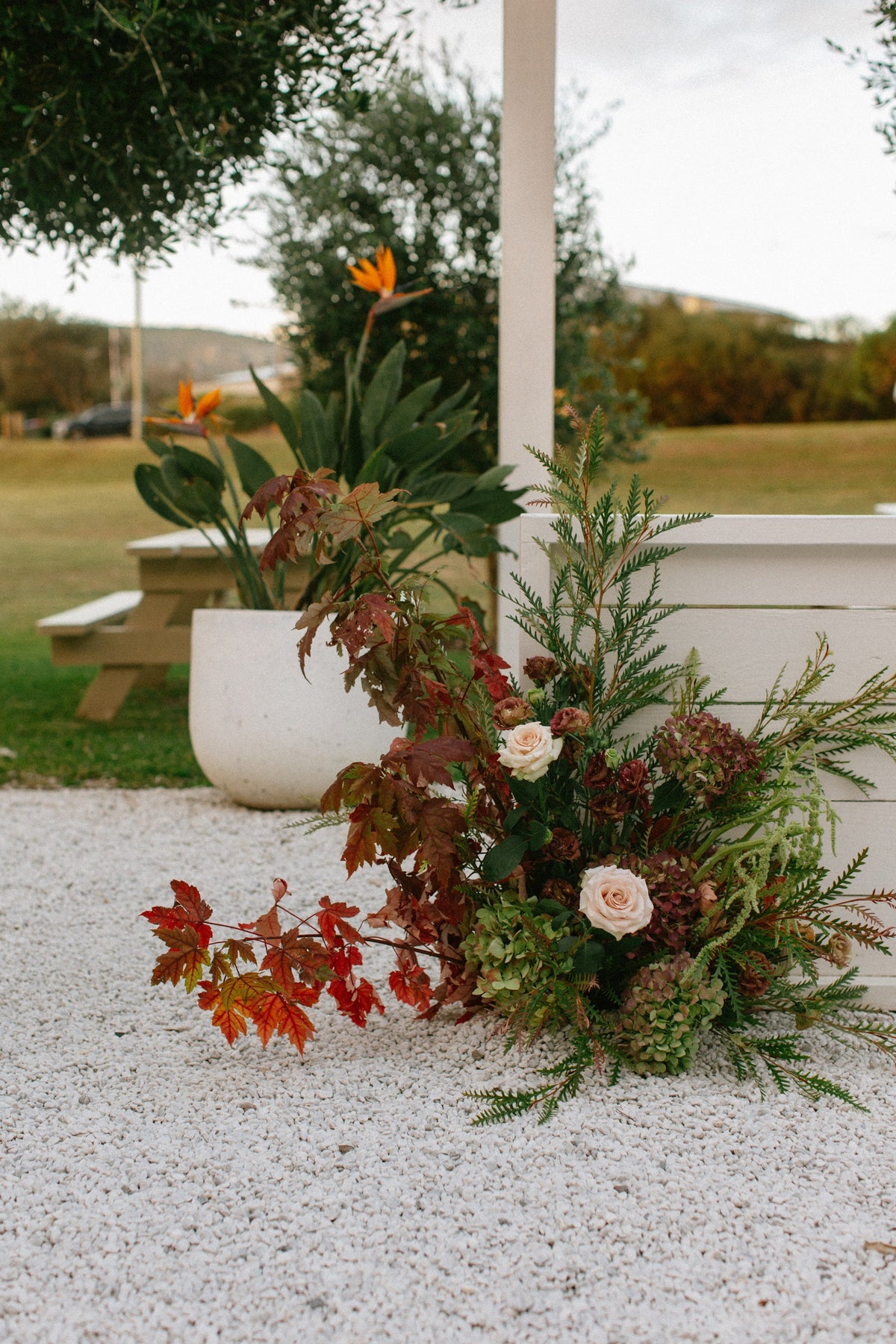
Your ceremony flowers are usually on show for about half an hour. Planned well, they work all night: behind the bridal table, on the bar, at the entrance, and then home with your guests. Moving flowers from the ceremony to the reception is the question couples ask us most, so here is how we plan it at Sydney venues, with real examples.


Before and after: two pillars at a home ceremony at Church Point, then at the entrance to Dunes for dinner, April 2026 (photos: Heartlands Studio).
Which Ceremony Flowers Move Well
The pieces that move best are the ones built to stand on their own.
- Arrangements on plinths or stands. They lift off and go straight to the bar, the seating chart or either end of the bridal table.
- Aisle and ground arrangements. They already sit on the floor, so they work beside the cake table, the gift table or the entrance.
- Floral pillars. A pair reads as an arch at the ceremony and as an entrance at the reception.
- Clusters on an arch or chuppah. We cut them down and fix them somewhere new: behind the bridal table, on a gazebo, along the bar.
Where they end up is part of the design from the start. Common spots are behind or in front of the bridal table, the bar, the seating chart, the cake and gift tables, the entrance, a photo corner, or a small table for family who can't be there. At Athol Hall, Sami and George's chuppah cluster moved to the gazebo for drinks, and the arrangements on wine barrels that marked the aisle went to the bar and the cake table.


Before and after: Sami and George's chuppah cluster, then on the gazebo for drinks (chuppah photo: Alex Carlyle Photography).
What Doesn't Move Well
- Sign flowers. Small pieces fixed to a welcome sign take more time to move than they're worth, so we usually leave them where they are.
- Hanging installations, while guests are underneath. At The Stables at Bendooley Estate, the clusters on the iron hoop can't come down during canapés, so we cut them down for the bar once everyone has moved inside.
- Anything the venue says stays put. Some venues have rules about when structures come down or where flowers can sit. We check these before we plan, so the plan still works on the day.
- Big arrangements split into small posies. A feature arrangement is built on mechanics that hold it together. It can move whole, but it can't be divided into neat table posies on the night. If you'd like both, we design bud vases alongside it.


Before and after: the hanging hoop clusters at Amy and Oliver's ceremony at The Stables, then on the bar once guests had moved inside, May 2026 (photos: Mathew Sacco).
Your Bouquets at the Reception
Bouquets get put down somewhere, so it's worth planning where. Long stems sit too high in most vases and block faces across the table. We usually lay the bridal and bridesmaid bouquets flat along the front of the bridal table, where they look lovely in photos. The cake table or gift table works too.
Some couples ask whether bridesmaid bouquets can double as table arrangements. It can work, with a few catches: empty vases need to be waiting on the tables, a bouquet is made to be seen from one side, it starts to wilt once it's out of water, and someone has to put each one in place. We'll tell you plainly whether it suits your day.
Who Moves Them, and When
When the ceremony and reception are at the same venue, our team stays on and moves the flowers while your guests have canapés and drinks, so the room is ready when everyone walks in.
When they're in two places, the plan changes. We wait at the ceremony, take the flowers down once photos are done, drive them over and set them up before guests arrive. That takes more time and sometimes more hands, so we build it into your plan from the start.
Three things decide what's possible:
- The gap. How long between the last photo at the ceremony and guests arriving at the reception.
- The venue's access times. When we can get into the reception room, and when we have to be out.
- The size of the pieces. A large backdrop can need an extra person to move safely.


Before and after: plinth arrangements at the ceremony, then on the floor at the end of a long table where guests see them as they walk in (photos: Mathew Sacco).
Send us your run sheet early. It's the quickest way for us to tell you what can move and where it should go.
If It Rains
When the ceremony moves inside the reception room, the ceremony flowers often stay where they are and become the backdrop for dinner. That's one less move on the day. Planning both versions early makes the wet-weather call much easier.
At the End of the Night
Most couples want guests to take the flowers home. A few things make that easy:
- Know which vases are yours. Bud vases can be bought for you to keep, so guests take them as they are. Hired vessels and stands have to come back, so ask your MC to mention it.
- Wrap loose stems. We can come back near the end of the night and wrap flowers from hired vessels into small bunches for guests to take.
- Moving pieces yourselves. If friends are taking a large arrangement home, the flowers can be cut free of the frame and fit in a car boot. High or hanging pieces need a ladder and the venue's okay, so leave those to us.
What to Do With Your Wedding Flowers After the Wedding
- Keep your bouquet going. Recut the stems and put it in fresh, cool water as soon as you can. Our guide to making flowers last longer has the details.
- Preserve it. If you'd like your bouquet pressed or set in resin, book a preserver before the wedding and ask how soon after the day they need it.
- Give flowers away. Friends, family and neighbours are the easiest home for them. If you'd like to donate, call first. Many hospitals don't accept flowers and aged care homes vary, so check before anyone drives over.
- Compost what's left. Flowers and greenery can go in a home compost, or your council's organics bin if it takes garden waste. Take out wire, ribbon and any floral foam first, because foam isn't compostable.
Common Questions
Does reusing ceremony flowers save money?
It makes your budget go further. One set of flowers does two jobs, so you pay for moving them rather than for a second set.
How long does it take?
At one venue, it's usually done during canapés. Across two venues it depends on the drive and the size of the pieces, and we plan it with your run sheet.
Can we move the flowers ourselves?
Simple pieces, yes. Large or high pieces are heavier and more fragile than they look, and some need a ladder and the venue's okay.
Can guests take the flowers home?
Yes, and we recommend it. Just make sure hired vases and stands stay behind.
More weddings where the ceremony flowers did two jobs: Sami and George at Athol Hall, Tayla and Hamish at Church Point and Dunes, and Amy and Oliver at Bendooley Estate.
Planning your own? Meet your Sydney wedding florist.
Love the photos? Meet the best wedding photographers in Sydney we've worked with.